
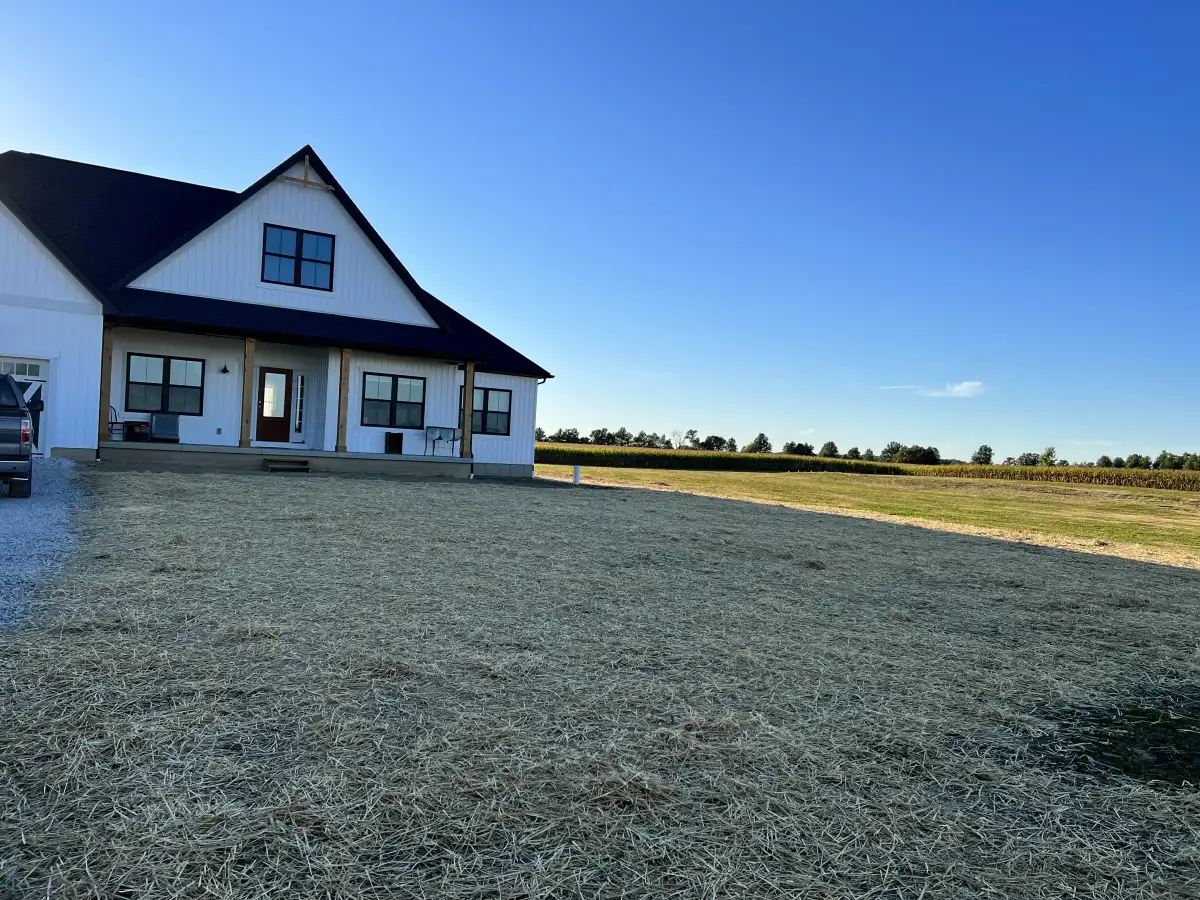
Standing water in your yard after a rainstorm is not just an eyesore. It is a warning sign that your property has a drainage problem that will get worse over time. In Central Ohio, May is when drainage issues become most visible because the combination of spring rains, snowmelt saturation, and warming soil creates conditions that expose every grading flaw and blocked water path on your property. If water is pooling, your grass is staying soggy for days, or you are noticing erosion channels forming in your lawn, this guide explains what is happening and what you can do about it.
At Raileys Services LLC, grading and drainage work is one of our core services. We have corrected drainage problems on hundreds of residential and commercial properties across Marysville, Dublin, Powell, Plain City, and the surrounding Central Ohio communities. This article covers the warning signs we see most often, why they happen, and the specific solutions that work in Union County's soil and climate conditions.
Why Drainage Problems Are Common in Central Ohio
Central Ohio sits on some of the heaviest clay soil in the Midwest. Clay soil is dense and compacts easily, which means it absorbs water very slowly compared to sandy or loamy soils. When rain falls faster than the soil can absorb it, the water has to go somewhere. On a properly graded property, it flows away from the house and toward designated drainage points. On a poorly graded property, it collects in low spots, pools against foundations, and saturates the root zone of your lawn and plantings.
Several factors make drainage problems particularly common in the Marysville and Union County area:
- Clay-heavy soil composition: Most properties in Union County have dense clay soil that drains slowly. After a heavy rain, water can sit on the surface for hours or even days before it percolates through.
- Flat to gently rolling terrain: Unlike hilly areas where gravity moves water naturally, the relatively flat terrain around Marysville means that even small grading mistakes create standing water.
- New construction settling: Jerome Village, the neighborhoods along US-33, and other newer developments in the area often have drainage issues because the fill soil used during construction compacts and settles over the first few years. What was graded properly at build time may no longer be draining correctly two or three years later.
- Spring weather patterns: May in Central Ohio typically brings 4 to 5 inches of rainfall, often in heavy bursts. This volume of water tests every drainage system and exposes weaknesses that drier months hide.
Seven Warning Signs of Yard Drainage Problems
Most drainage problems announce themselves clearly if you know what to look for. Here are the seven most common signs we encounter on properties throughout Central Ohio.
1. Standing Water That Lasts More Than 24 Hours
Some temporary puddles after a heavy rain are normal, especially on clay soil. But if you have areas of your yard where water sits for more than a day after the rain stops, you have a drainage problem. The most common locations are along the foundation, in the center of the backyard, at the base of slopes, and in the transition zone between your property and a neighbor's. Standing water breeds mosquitoes, kills grass, and indicates that the ground is not directing water where it needs to go.
2. Soggy or Spongy Lawn Areas
If sections of your lawn feel spongy underfoot even when it has not rained recently, the soil underneath is holding water it cannot drain. This is different from a surface puddle. The water is trapped in the root zone, suffocating your grass roots and creating conditions for fungal diseases like brown patch and dollar spot. In Marysville's clay soil, this often happens in low areas that were never properly graded during initial construction or landscaping.
3. Erosion Channels and Bare Spots
When water flows across your lawn with enough force to move soil, it carves channels. You will see these as shallow ditches or ruts that follow the path of water runoff. Over time, these channels deepen and widen, washing away topsoil and leaving bare spots where grass cannot establish. Erosion is especially common on slopes, near downspout discharge points, and along the edges of driveways where concentrated runoff hits unprepared turf.
4. Water Stains or Dampness on Your Foundation
If you see water marks, efflorescence (white mineral deposits), or dampness on the exterior of your foundation walls, water is making contact with the foundation instead of draining away from it. This is the drainage problem that homeowners should take most seriously. Persistent water contact with your foundation can lead to basement leaks, structural cracking, mold growth, and significant repair costs. The solution is almost always a grading issue: the ground around your house should slope away from the foundation at a minimum of 1 inch per foot for the first 6 feet.
5. Downspouts Dumping Water Next to the House
Gutters and downspouts collect a significant volume of water from your roof. If your downspouts discharge directly at the base of the foundation without extensions or underground drainage, they are concentrating thousands of gallons of water right where it can do the most damage. In a heavy May rainstorm, a typical 2,000-square-foot roof can produce over 1,200 gallons of water. All of that water needs to be directed at least 6 to 10 feet away from the foundation.
6. Mulch Washing Out of Landscape Beds
If your mulch migrates after every rain, water is flowing through your landscape beds with too much force. This usually means the beds are not edged properly, the grading directs water into the beds instead of around them, or the beds lack any form of water management. Beyond the inconvenience of replacing mulch, this runoff is also carrying soil and nutrients away from your plantings.
7. Neighbor's Water Running Onto Your Property
Water does not respect property lines. If a neighboring property sits higher than yours, or if their grading directs runoff toward your yard, you may be dealing with drainage volume that your property was never designed to handle. This is a common issue in subdivisions around Marysville where lots are relatively flat and close together. The solution usually involves intercepting the water at your property line with a French drain or swale before it reaches your lawn and foundation.
Professional Drainage Solutions That Work in Central Ohio
Once you have identified a drainage problem, the next question is how to fix it permanently. Here are the solutions we install most frequently on properties throughout Union County and the surrounding area.
Yard Regrading
Regrading is the most fundamental drainage solution and often the most effective. It involves reshaping the contour of your yard so that water flows in the right direction: away from the foundation, toward the street or a designated drainage area. For properties with settlement issues or poor initial grading, regrading alone can solve the problem without any additional drainage infrastructure. We use laser-guided grading equipment to ensure precise slope calculations. After regrading, we seed or sod the disturbed areas to reestablish turf.
French Drains
A French drain is a trench filled with gravel and a perforated pipe that collects subsurface water and redirects it to a discharge point. French drains are effective for intercepting water that flows through the soil, making them ideal for properties where surface grading alone is not enough. We typically install French drains along foundation walls, at the base of slopes, along property lines where neighbor runoff enters, and in persistently wet lawn areas. A properly installed French drain with landscape fabric to prevent sediment clogging can last 15 to 20 years or more.
Surface Drains and Catch Basins
Surface drains collect standing water from low spots and route it through underground pipes to a discharge point. Catch basins are installed at the lowest point of a problem area and connect to a buried pipe system. This solution works well for large flat yards where regrading the entire area is not practical, for patio and hardscape areas that trap water, and for collecting downspout discharge and routing it away from the house underground.
Downspout Extensions and Underground Routing
For homes where downspouts are the primary source of foundation water contact, extending or burying the downspout discharge is often the simplest and most cost-effective fix. We connect the downspout to a buried corrugated pipe that carries the water 10 to 20 feet away from the foundation before discharging it at grade. This keeps the water off the lawn surface entirely, eliminating both foundation contact and surface erosion near downspout locations.
Dry Creek Beds and Swales
For properties with natural water flow paths across the yard, a dry creek bed or swale can manage the flow while adding a visual element to the landscape. Swales are shallow, gently sloped channels that guide water without eroding the lawn. Dry creek beds are lined with river rock and function like a natural stream channel during rain events. Both solutions work with the natural flow of water rather than fighting against it, which makes them more reliable over time. We often pair these with new landscape plantings along the edges for a finished, intentional look.
How Much Does Drainage Work Cost in Marysville?
Drainage project costs vary significantly based on the scope of the problem and the solution required. Here are the typical ranges for residential properties in the Marysville area:
- Downspout extensions and burial: $300 to $800 per downspout, depending on pipe length and discharge location.
- Yard regrading (partial): $1,000 to $3,500, depending on the area size and how much soil needs to be moved. Includes seeding of disturbed areas.
- French drain installation: $1,500 to $5,000, depending on the length and depth. A 50-foot French drain with proper gravel, pipe, and fabric typically falls in the $2,500 to $3,500 range.
- Surface drain and catch basin system: $1,200 to $4,000, depending on the number of drains and total pipe run.
- Comprehensive regrading (full yard): $3,000 to $8,000+ for properties that need significant reshaping.
For a more detailed breakdown of landscaping project costs, see our landscaping cost guide for Marysville. We provide free on-site estimates that include a detailed scope of work and clear pricing so you know exactly what the project will cost before we start.
When to Call a Professional
Some drainage issues are straightforward enough for a homeowner to address. Extending a downspout with an above-ground extension or regrading a small area next to the foundation with a wheelbarrow of topsoil are reasonable DIY tasks. However, you should call a professional when:
- Water is reaching or entering your foundation, basement, or crawlspace.
- Erosion is worsening after each rain event despite your efforts.
- You have standing water in multiple areas across your property.
- The problem involves water flowing from a neighbor's property onto yours.
- You need to install a French drain, catch basin, or underground pipe system.
- Your grading needs to be corrected with heavy equipment.
Drainage work that involves digging, trenching, or regrading with equipment also requires awareness of underground utility locations. We always call 811 before any excavation to have utilities marked. Hitting a gas line, water main, or buried electric cable is a safety risk that no homeowner should take on without proper preparation.
Fix It Now Before Summer Makes It Worse
May is the ideal time to address drainage problems in Central Ohio. The spring rains make the problems visible, the soil is workable, and you have time to get corrections in place before the summer heat arrives. Waiting until summer means the soil dries out and hardens, making grading and trenching more difficult and more expensive. Waiting until fall means you have lived with the problem all season, and any turf damage from standing water may not recover before winter dormancy.
If you are seeing any of the warning signs described in this article, the next step is a professional site evaluation. We walk your property, identify the root causes, and recommend solutions that match the specific conditions on your lot. Every property is different, and the solution that works for your neighbor may not be the right one for you.
Call us at (937) 243-9488 or request your free drainage evaluation online. We serve Marysville, Dublin, Powell, Plain City, Bellefontaine, Jerome Village, and communities throughout Central Ohio.